

Modern business moves faster than human output. The shift toward AI writing tools isn’t about cutting corners; it is about solving the fundamental problems of traditional content creation: unpredictability, high costs, and slow scaling.
Here is how businesses are successfully making the transition.
1. The Real Problem: Human Friction
For most companies, the issue isn’t a lack of talent—it’s instability. Human writing is often delayed by “writer’s block,” personal schedules, or varying quality levels.
- The Cost of Delay: Research shows that consistent content creators see 67% more leads than those who publish irregularly.
- The Solution: AI provides a “predictable floor.” It removes the emotional and physical fatigue that causes human writers to miss deadlines or produce uneven work.
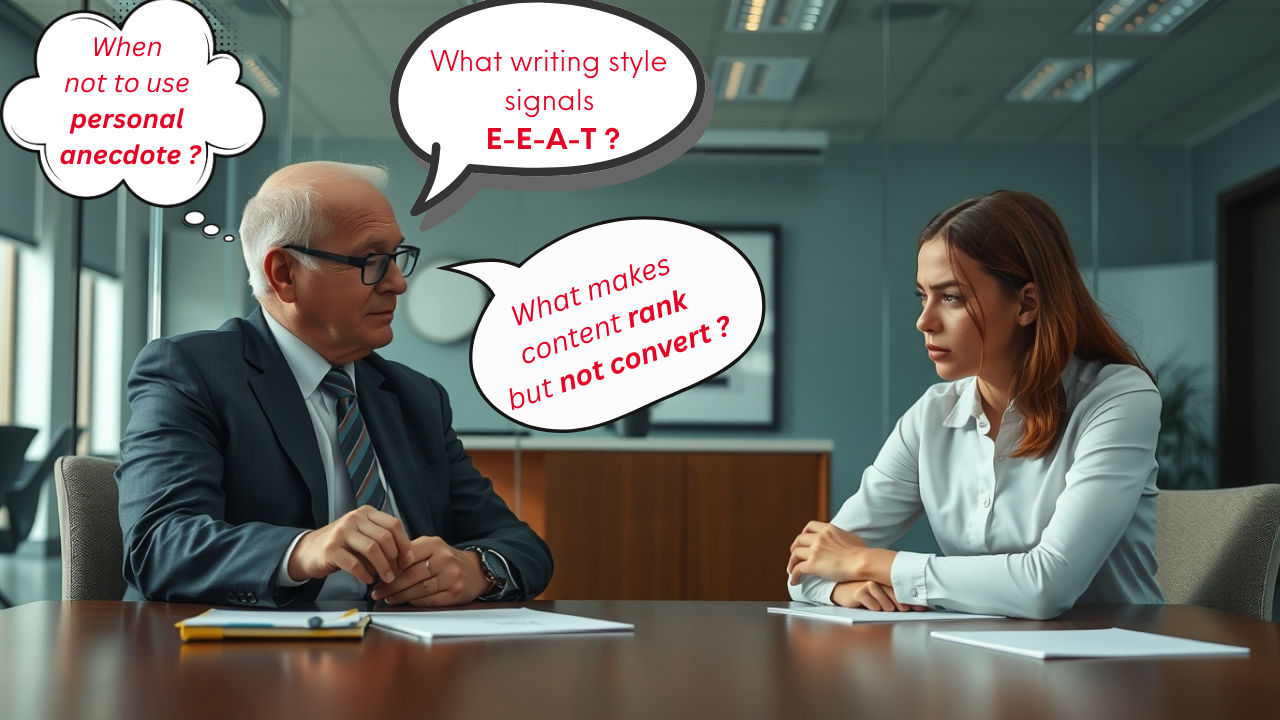
Because my team works with writers from platforms like Upwork, Fiverr, and social media, I see their skills very closely. In most cases, writers are good at talking and presenting themselves, but many do not understand content deeply. They often lack knowledge about search intent, structure, and content optimization. Many call themselves experts, but their expertise is mostly in communication, not in full content planning and performance.
This creates human problems in content work. Many writers do not understand how different writing styles affect results like ranking, traffic, and engagement.
For businesses, it becomes very difficult to identify which writer or team truly understands content from start to finish, and which one only knows basic writing. This uncertainty costs time, money, and energy.
2. Why Early AI Failed (And What Changed)
The first wave of AI content failed because people used it for the wrong tasks. Early adopters asked AI to “be creative” without giving it a map. This resulted in “hallucinations”—where AI creates false information—or content that felt robotic and generic.
Then businesses tried another layer of hallucination called AI humanizer. They just ensured their content passes AI check, which is NEVER a ranking or quality parameter.

The Problem: The “Magic Button” Myth
Many companies thought they could just press a button and get a perfect article. This failed because AI works best as a processor, not a planner. Without a clear structure, the output lacked the depth required by modern readers and search engines.
The Solution: Separating Strategy from Execution
Modern businesses have fixed this by splitting the writing process into two parts:
- Human Strategy: Deciding which topics matter and what the goals are.
- AI Execution: Taking those goals and turning them into thousands of words of clean, accurate text instantly.
To replace writers successfully, businesses treat AI as an execution engine. They provide the “logic” and “intent” via a dedicated system, and the AI handles the “volume.” This removes the risk of human error and the high cost of human labor while keeping the content high-quality.
Data-Driven Success
Studies show that when AI is used as a tool for specific tasks rather than a total replacement for thought, productivity spikes. A study by Harvard and MIT found that using AI for writing-related tasks helped workers complete 12% more tasks and finish them 25% faster, with significantly higher quality scores.
Why You Need a System, Not Just a Chatbot
Simple chatbots are not enough for a growing business. To scale, you need a dedicated AI writer tool that enforces rules:
- Fixed Outlines: Ensuring every article follows a proven logic.
- Brand Voice: Making sure the AI never sounds like a machine.
- Accuracy Checks: Using systems that verify data before it is published.
By moving from “chatting” to “systematic writing,” businesses can produce content that ranks higher and costs 90% less than traditional methods.
3. The Shift from Inspiration to Reliability
Most business content does not need to be a literary masterpiece. It needs to be useful, accurate, and findable. In the past, companies relied on “inspired” writers, but inspiration is not a scalable business model.
Reliability Over Brilliance
Businesses are moving away from individual writing styles toward standardized systems. An AI writer tool ensures that every piece of content meets the same high standard, every time. There are no “bad days” or “off-brand” moments.

- Search Engine Standards: Google’s Helpful Content guidelines prioritize information that provides a good user experience. Google explicitly states that using AI to generate content is not against their guidelines, provided it is high-quality and created for people.
- The Scalability Advantage: A human writer can produce perhaps 2,000 words a day. An AI system can produce 200,000 words that are all formatted, optimized for SEO, and ready for review.
Businesses use AI writing tools to ensure predictability. By removing the need for “creative inspiration,” companies can treat content like a manufacturing line where the quality of the output is guaranteed and the cost per article is drastically reduced.
Performance-Driven Writing
Readers do not search for “creative prose” when they have a problem; they search for clear answers.
- Fact: According to Microsoft research on AI productivity, 70% of workers would delegate as much work as possible to AI to lessen their workloads.
- Result: By using a dedicated AI writer, businesses stop paying for “writing hours” and start paying for “results.” This allows the company to focus on growth while the system handles the heavy lifting of content creation.
4. Total Control Over Content Infrastructure
When a business relies on human writers, they are dependent on individuals. When they use an AI writing system, they own the infrastructure.
| Metric | Human Writer | AI Writing System |
| Speed | 4–6 hours per post | < 2 minutes per post |
| Consistency | Varies by mood/day | 100% Fixed Tone |
| Availability | Working hours only | 24/7 On-Demand |
| Scalability | Limited by headcount | Unlimited |
5. Content Quality Didn’t Disappear — It Normalized
What changed wasn’t the “ceiling” of quality; it was the “floor.” Before AI, business content was a gamble—one article might be great, while the next was poor or unfinished. With an AI writer tool, businesses achieve a “normalized” standard that is consistently high.
Predictable Quality is a Business Asset
In the traditional model, quality depends on a writer’s mood or energy. AI removes this variable. Every article has the same clear structure, proper depth, and professional tone. This predictability is what allows a business to scale.
- Higher Accuracy: Modern AI systems can be programmed to cross-reference facts instantly. According to recent productivity research, AI tools help workers produce higher-quality output by reducing common errors and improving clarity. (source: Research Paper- Generative AI at Work).
- Better Trust: Readers trust sites that provide direct, clear answers. Research from Google’s Search Quality Guidelines shows that “helpful, reliable, people-first content” is the primary factor for ranking. AI tools are designed specifically to follow these guidelines perfectly every time.
Why “Normal” is Better than “Creative”
Most people searching the web aren’t looking for poetry; they are looking for solutions.
Businesses use AI to normalize quality because search engines and readers reward consistency. An AI writer tool ensures that every page has the correct depth and tone, which eliminates the need for constant human revisions and ensures that the “brand voice” never fails.
The Impact on Performance
When your content quality is predictable, your growth becomes predictable.
- Fewer Revisions: AI systems follow your rules the first time, saving hours of editing.
- Faster Indexing: Search engines like Google can more easily understand and rank content that is well-structured and logical.
- Cost Efficiency: Since the “floor” of quality is higher, businesses spend 80% less time fixing bad drafts and 100% more time on strategy.
The Bottom Line
AI did not replace writers because it is “smarter.” It replaced them because it is controllable. In a world where search engines reward volume and accuracy, a systematic AI writing tool is no longer an option—it is a requirement for survival.

Creator of NanyBot. Currently serving as the Director of R&D at NanyBot.
Partho Protim is a versatile software engineer and visionary strategist in AI-driven content creation. With a proven record of transforming complex algorithms into powerful content tools, he empowers creators and brands to boost rankings and drive conversions. His clear, actionable insights simplify even the most intricate digital challenges. Trust Partho to guide you in using AI to create content that captivates audiences and delivers real results.
He has reverse-engineered top-ranking AI content systems, built proprietary frameworks from scratch, and consistently stays ahead of trends in SEO and generative tech. With a deep understanding of both algorithms and human psychology, Partho creates content strategies that not only rank—but resonate. Brands and founders across industries rely on his guidance to stay competitive in the AI era.