 nanybot

A trial version is the golden opportunity a software company has to convince potential customers that its product is worth paying for.
Yet many SaaS companies make a fundamental mistake: they restrict the very capabilities customers need to evaluate before making a purchase.
They hide advanced features, disable important functionality, or offer an experience significantly different from the paid product.
This might seem like a good way to encourage upgrades. In reality, it can drive potential customers away.
Think about it: how can someone decide whether your software is worth buying if they cannot properly evaluate what it can do?
There is a better approach:
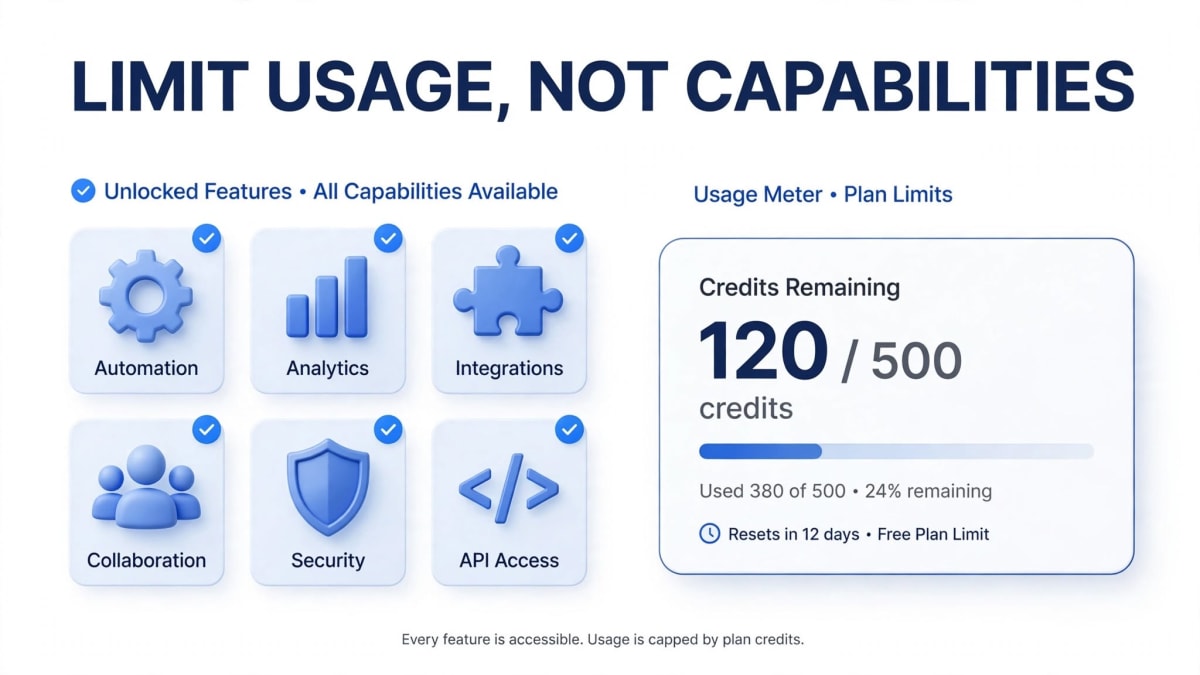
Limit how much users can use your software, not what your software can do.
Give trial users access to every capability. Control resource consumption through usage quotas, credits, or trial duration rather than compromising the product experience.
Let's explore why this matters and how to implement it.
1. What Is a Trial Version Really For? #
The purpose of a trial is to help potential customers decide whether your software solves their problems well enough to justify purchasing it.
Before paying, customers want to know:
Does it solve my actual problem?
Does it have the features I need?
Can it handle my particular use case?
Is the output quality good enough?
Is it better than the alternatives?
A trial should let them answer these questions through actual experience.
Consider a video editing application offering automatic subtitles, AI scene detection, background removal, and advanced audio processing.
A potential customer wants to evaluate whether it can handle their editing workflow. But the trial only allows basic trimming and exporting.
They cannot evaluate most of the product's value.
The company might argue that advanced features are available after purchasing. But why should customers pay for functionality they haven't been able to test?
A trial should demonstrate the actual value of a product, not merely introduce its interface.
2. Usage Limits vs. Capability Limits #
There are two fundamentally different ways to restrict a trial.
Usage limits control how much a customer can use the software.
Capability limits control what a customer can do with it.
Usage limits | Capability limits |
|---|---|
10 AI generations | Disable advanced AI models |
5 video exports | Disable high-quality exports |
100 API requests | Disable API integration |
7-day trial | Remove important features |
5 projects | Restrict project functionality |
100 processing credits | Disable advanced processing |
The distinction is important.
With usage limits, customers experience the complete product within a defined allowance.
With capability limits, customers might never discover what the product can actually do.
Imagine two applications:
Product A offers 5 out of 20 features with unlimited trial usage.
Product B offers all 20 features but allows only 10 operations.
Product B provides a much better opportunity to evaluate the actual product.
The customer can test whichever features matter to their workflow, even if their usage is limited.
A trial should be functionally complete but quantitatively limited.
3. Let Users Experience What They Are Actually Buying #
Customers don't purchase software simply because it has an impressive feature list. They purchase it because those features help them achieve something.
A business owner buys accounting software to manage finances. A content creator buys editing software to produce videos efficiently. A developer buys AI coding tools to reduce development time.
Features are the means. Results are the reason people pay.
This creates a problem when important capabilities are hidden behind a payment barrier.
Consider an AI writing application offering:
Long-form article generation.
Brand voice customization.
SEO optimization.
Document analysis.
Multiple AI models.
A customer might specifically need document analysis and brand voice customization.
If those features are unavailable during the trial, the customer cannot determine whether the software meets their requirements.
Even if the product performs exceptionally well, they might leave without discovering it.
You cannot reliably predict which features will convince someone to purchase.
Let customers evaluate the complete product and discover its value themselves.
4. My Experience With Feature-Limited SaaS Trials #
I have used many SaaS products that offer only a handful of features in their trial versions.
In several cases, I never even considered purchasing them.
The reason was simple: I couldn't determine their actual capabilities.
I wasn't necessarily looking for unlimited usage. I wanted to understand what the software could do and whether it could solve my particular problem.
When important features were unavailable, I had no reliable way to evaluate the product.
Why should I invest time learning an application and potentially integrating it into my workflow when I cannot even verify whether its full capabilities meet my requirements?
The company might believe that hiding advanced features encourages upgrades.
But from the customer's perspective, those restrictions can eliminate the very reason to upgrade.
A trial that allows unlimited use of an incomplete product isn't necessarily more valuable than one that provides limited access to the complete product.
5. Perceived Quality Matters More Than Usage Quantity #
Customers evaluate software based on what they experience, not its internal architecture or resource allocation.
That experience shapes their perception of product quality.
Imagine two AI applications:
Application A allows 100 generations per day but provides access to a less capable model.
Application B allows only 10 generations per day but provides access to its most capable model.
For someone who values response quality, Application B might be considerably more attractive.
Application A offers more interactions, but those interactions might repeatedly reinforce the perception that its output is mediocre.
Application B offers fewer interactions, but each one demonstrates its actual capabilities.
The same principle applies beyond AI.
Consider two graphic design applications:
One allows unlimited exports but restricts resolution.
Another allows five exports at the same quality available in its paid version.
The second application provides a more accurate representation of what customers are buying.
A smaller number of excellent experiences can create more confidence than a larger number of mediocre ones.
6. ChatGPT vs. Claude: An Interesting Observation #
I want to share a personal observation from my experience with AI products.
For a long time, I gradually lost confidence in ChatGPT because of what I perceived as declining response quality.
Its responses increasingly felt less intelligent, less useful, and less capable of understanding complex requests.
I almost concluded that ChatGPT's overall quality had deteriorated.
Then I reconsidered my usage pattern. I primarily use the free version, and I use it quite heavily.
I started wondering whether heavy free usage might result in access to less capable models or different levels of processing.
I don't know what happens internally, and I have no evidence of OpenAI's model allocation decisions. This was simply a hypothesis based on my experience.
Then I compared that experience with Claude.
Claude imposes considerably tighter usage limits on its free version, based on my experience. However, the responses I receive within those limits often maintain a high level of quality.
This created two very different impressions:
Claude appeared to offer greater intelligence and stronger capabilities, despite allowing fewer interactions.
ChatGPT appeared less capable because I frequently received responses that didn't meet my expectations.
Perhaps both companies are managing their free-user resource consumption in different ways. I don't know whether their actual resource allocations are comparable.
But the difference in user perception is interesting.
Even when usage is restricted, maintaining response quality can help preserve confidence in a product.
If ChatGPT had offered me fewer interactions but consistently maintained the response quality I expected, I might never have lost confidence in it.
The lesson for SaaS founders is broader than AI:
Don't compromise the quality of the experience simply to provide more usage.
7. The Hidden Business Cost of Capability Restrictions #
Restricting features can create several costs that aren't immediately visible.
Losing potential customers before they understand your product
A customer arrives with a specific problem. The feature needed to solve it is unavailable. They leave without discovering whether your product could have helped.
Creating an inaccurate product perception
Customers judge what they can access. If the trial feels incomplete, they might assume the entire product is limited.
Making competitors look better
A competing product with fewer overall capabilities might appear superior simply because its trial provides a more complete experience.
Increasing purchasing uncertainty
Customers cannot confidently purchase functionality they haven't tested. They must rely on marketing promises instead of actual results.
Damaging long-term brand perception
Even if customers don't purchase immediately, their trial experience can influence whether they consider your product again.
A trial should reduce purchasing uncertainty, not create it.
8. How to Control Trial Costs Without Limiting Capabilities #
Resource consumption is a legitimate concern, particularly for SaaS products involving AI APIs, video processing, cloud storage, and expensive infrastructure.
But restricting capabilities isn't the only way to control costs.
Consider these alternatives.
Usage quotas #
Allow a fixed number of operations during the trial.
For example:
10 AI generations.
5 video exports.
20 document analyses.
100 API requests.
Each operation should provide the same functionality and quality as the paid version.
Credit-based systems #
Different operations can consume different amounts of credits.
Operation | Credits |
|---|---|
Basic AI generation | 1 |
Long-form generation | 5 |
Document analysis | 3 |
Video processing | 10 |
This allows customers to experiment with different capabilities while keeping resource consumption predictable.
Trial duration #
Provide complete functionality for a limited period, such as 7 or 14 days.
Customers can evaluate the product without receiving indefinite free access.
Resource-based restrictions #
Some operations consume considerably more resources than others.
For example, a video application could allow every editing feature but limit total processing minutes.
An AI application could provide access to every model but allocate a fixed number of credits.
The objective is to control consumption without deliberately weakening the result.
You can also combine trial duration, credits, storage limits, and project limits according to your business model.
9. The Other Side: Users Who Exploit Free Trials #
There is a legitimate concern with offering full product capabilities: some users deliberately create multiple accounts to repeatedly access free trials.
They might use the software for months or even years without ever becoming paying customers.
This is particularly problematic for products with expensive operational costs and minimal barriers to account creation.
Possible measures include:
Phone number verification.
Payment method verification.
Device-based trial tracking.
Account and usage monitoring.
Restrictions designed to detect repeated trial abuse.
None of these approaches is completely foolproof.
And this introduces a genuine business trade-off.
You must weigh two competing risks:
Restricting capabilities: You might lose genuine customers because they cannot properly evaluate your product.
Providing full capabilities: You might attract users who repeatedly exploit free trials without ever paying.
There is no universal answer.
The right decision depends on your product, target audience, operational costs, customer acquisition strategy, and likelihood of trial abuse.
This is a decision you have to make for your own business. Neither I nor anyone else can recommend a universally correct approach without understanding those factors.
However, if you provide sufficient information about your product and business model, an experienced SaaS consultant can help evaluate the trade-offs and recommend an appropriate strategy.
The important point is that capability restrictions should be a deliberate business decision, not an automatic default.
10. Don't Confuse a Free Plan With a Trial Version #
A free plan and a trial version serve different purposes.
A free plan is generally designed for ongoing use, often with restrictions that encourage upgrades.
A trial is designed to help potential customers evaluate the paid product.
For example, a project management application might offer a permanent free plan with:
A limited number of projects.
A small team size.
Basic reporting.
Limited storage.
That can be a perfectly reasonable business model.
However, a 14-day trial of its premium product should ideally provide access to all premium capabilities.
Otherwise, customers cannot properly evaluate what they would receive after purchasing.
A free plan can be a limited product offering. A trial should be a limited opportunity to experience the complete product.
11. Your Trial Is Part of Your Product Experience #
Many companies treat trials primarily as conversion mechanisms. Their focus is on getting users to upgrade.
But a trial is also an actual product experience.
Customers interact with the interface, test functionality, evaluate performance, and form opinions about reliability.
Every interaction influences their perception of the product.
Consider the customer journey:
Discover the software.
Become interested in its capabilities.
Register for a trial.
Try to solve an actual problem.
Evaluate the results.
Decide whether the product is worth purchasing.
The trial is where you must demonstrate your value.
If customers cannot experience the complete product until after purchasing, you are asking them to pay for something they haven't properly evaluated.
That might work for established brands with strong customer trust.
For an unfamiliar SaaS product competing against established alternatives, it creates an unnecessary disadvantage.
Your trial should build purchasing confidence, not require customers to purchase before they can develop it.
final though -
Prove Your Value Before Asking for Payment #
A trial version is your opportunity to demonstrate why your software deserves a place in someone's workflow.
Don't waste that opportunity by presenting an artificially weakened version of your product.
If your software has 20 valuable features, let customers experience all 20.
If your AI application produces excellent results, let them experience that quality.
If your application offers advanced processing, integrations, or automation, let potential customers test those capabilities.
Control operational costs through usage quotas, credits, storage limits, and trial durations.
Of course, consider the possibility of trial abuse and make an informed decision based on your business economics.
The goal isn't to provide unlimited free access. It's to give genuine potential customers enough opportunity to evaluate the real product.
Limit how much users can use your product, not what your product can do.